

Voxxy
The orange companion. Light, curious and quick on its feet — the one players will want to control.
 ROBOT GAMES
Voxxy, Droid and Biggy are yours. The Kinepolis Antwerp floor plan is your level. Use generative AI to turn them into a game people can actually play. Three entries win Devoxx Belgium tickets, and the winner demos their game on the opening keynote stage.
Build a playable game, set in the Kinepolis Antwerp, in which all three robots appear and matter. How you build it is up to you — any engine, any language, any stack, and any dimension. What we are looking for is an idea we have not seen, built well: robots that move like machines with weight, a venue you recognise, and rules worth playing more than once.
That freedom covers the form as much as the stack. Flat 2D, full 3D, VR, mixed reality that drops Biggy onto your desk — all of it is in scope, and none of it scores points for its own sake. Nothing in the criteria below rewards a third dimension, so a sharp 2D game beats a vague 3D one. Pick the form your idea actually needs, then be as inventive with it as you can.
Generative AI is the point, not a shortcut you need to hide. Model the robots with it, generate the environment with it, write the code with it, compose the audio with it. Any model is fair game — Claude, Gemini, GPT 6 Astra, a Llama running on your own laptop, whatever you reach for. We score how well you directed it, not whose logo was on it, so tell us what you used and keep your prompts and notes in the repo.
LICENSE file. We want the winning entries to be something anyone can learn from and build on.The orange companion. Light, curious and quick on its feet — the one players will want to control.

Tall, weathered and deliberate. Exposed joints and scuffed panels — it has been in this building a long time.

Short legs, heavy armour, no hurry. Slow to start and hard to stop once it is moving.
Model sheets, the floor plan and starting prompts are on the reference page. The orange robot walking around the Robot Lab is a reference only — one possible look and feel for the Voxxy sheet, there to show the sheets are enough to build from. Read its source if it helps, but do not ship it: build your own robots from the model sheets. An entry that is this robot with a new coat of paint scores nothing on the 40 points for originality.
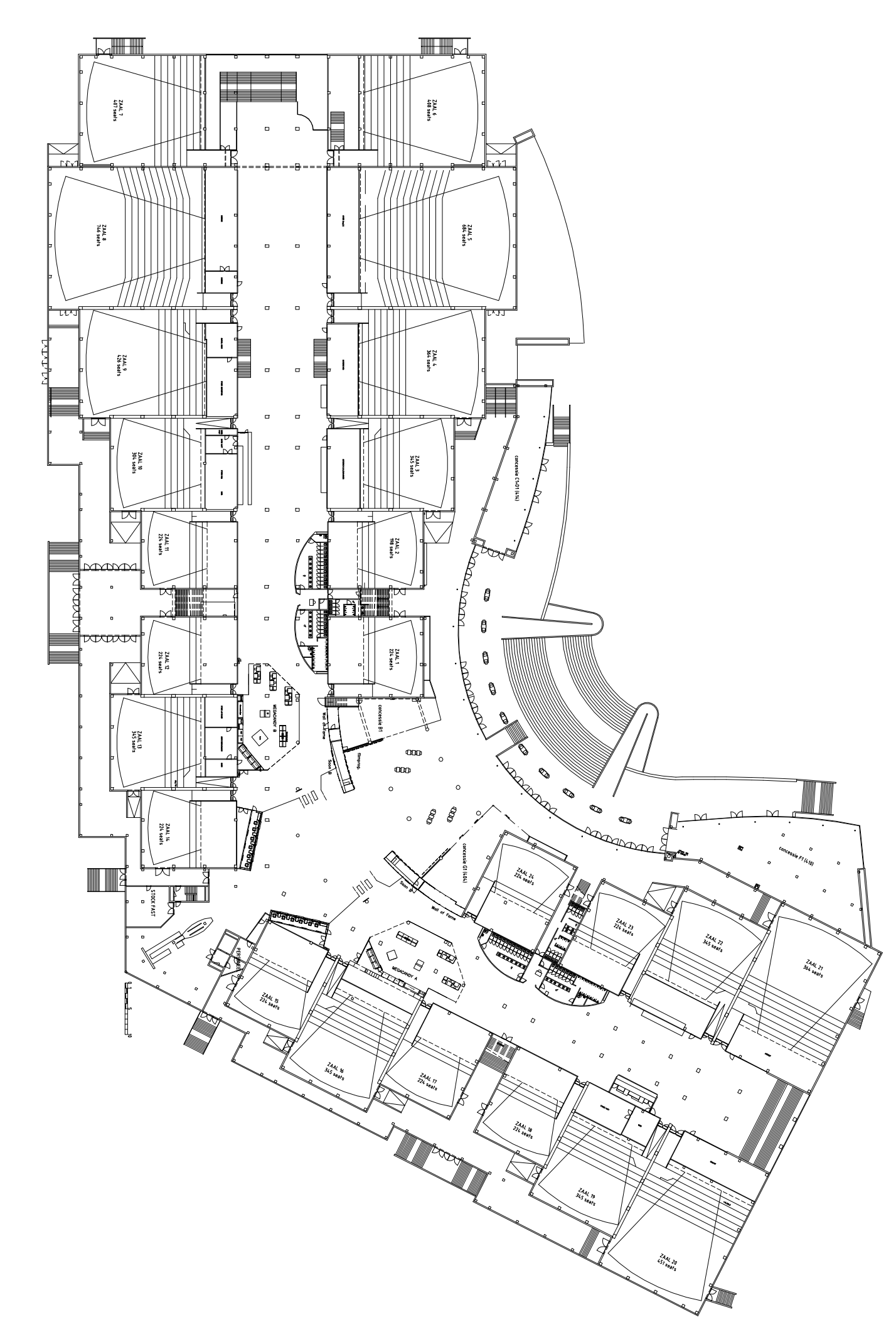
Devoxx Belgium runs in the Kinepolis Antwerp, and so does your game. The floor plan gives you the real thing: numbered auditoriums, the corridors between them, the stairs and the entrance areas.
You do not have to model every room. You do have to make the place recognisable to the several thousand developers who will spend a week walking through it.
For what it actually looks like, the archive on Flickr has thousands of shots from previous editions — the auditoriums, the foyer, the signage, the light. They are copyleft, so use them freely as texture, lighting or render references.
A panel of Devoxx judges plays every entry and scores it out of 100. Originality carries the most weight — we would rather play one surprising idea than another competent clone — but a clever idea nobody can actually play will not win either.
Show us something we have not seen. An unexpected genre, mechanic or reading of the brief beats a polished copy of a game that already exists. This is the largest single score, so spend your ideas here.
Do the robots move like machines with mass, and does the space behave like a building? Weight, momentum, contact with the floor, light that belongs in a cinema.
A clear goal, controls that explain themselves, honest feedback, and a reason to start a second round.
Voxxy, Droid and Biggy each do something only they can do. Three reskins of the same character score low here.
We should know it is the Kinepolis before anyone tells us.
How you directed the tools, documented in the repo — prompts, iterations, and what you fixed by hand when the model got it wrong.
A free Devoxx Belgium combi ticket, and you demo your game live during the opening keynote.
A free Devoxx Belgium conference ticket.
A free Devoxx Belgium Deep Dive ticket.
Together that is €2,135 worth of Devoxx Belgium 2026 tickets on the table, excluding VAT. Enter as an individual or as a team. Each prize is one ticket per entry, not one per team member, so a team nominates the person who submits, receives the ticket and — for first place — takes the stage.
A public GitHub repository is all we need. Submit as often as you like before the deadline — we judge your most recent entry, so an early submission costs you nothing.